Villa Albertine

Université Paris-Saclay
#13 in the World
#1 in France and Continental Europe
Source: ARWU Shanghai Ranking, 2025
Université Paris-Saclay is a research-intensive university with a vast European and international reach. It is one of the world’s leading universities, ranked among top universities: 13th in 2025 ARWU – Shanghai Rankings (2nd for mathematics, 6th for physics, 19th for ecology, 27th for atmospheric science), 76th in QS 2027, and 68th in THE 2026 global rankings.
Université Paris-Saclay brings together five faculties (Sciences; Medicine; Pharmacy; Law, Economics & Management; Sports Sciences), four “Grandes écoles” (CentraleSupélec; AgroParisTech; ENS Paris-Saclay; Institut d’Optique Graduate School), three university technology institutes, one university engineering school, and two associate member universities (Université de Versailles Saint-Quentin-en-Yvelines, Université d’Evry).
It offers more than 500 master degree programs to over 9,000 students from nearly 130 countries, and over 100 undergraduate programs. It hosts 4,500 PhD students in 21 doctoral schools, 40% of whom are international. With more than 220 laboratories, 500 experimental platforms, 8,100 researchers and teacher-researchers, and partnerships with six national research organizations (CEA, CNRS, INRAE, INRIA, INSERM and ONERA), at the heart of a vibrant innovation ecosystem, Université Paris-Saclay represents 13% of French research.
Eligible Programs for Lafayette Fellows
List of Master 1 programs (2-year programs, fully taught in English):
Bioinformatics / Computational Biology
Chemistry
Computer Science
- Artificial Intelligence
- Data, Knowledge and Hybrid Artificial Intelligence
- Distributed, Parallel and Quantum Computing
- Human-Computer Interaction
Economics
Electrical Engineering
Fundamental and Applied Physics
Industrial Engineering
Nuclear Energy
Pharmaceutical Science
List of Master 2 programs (1-year programs, fully taught in English):
Important: Applicants should carefully review the academic and scientific prerequisites for each M2 program. Please note that, for some programs, Université Paris-Saclay requires applicants to have successfully completed the first year of a Master’s degree (M1) and does not consider a U.S. Bachelor’s degree to be equivalent to an M1. If you are unsure whether your academic background meets the requirements of a specific program, please contact the relevant program director before applying.
Agrosciences, Environment, Territory, Landscape, Forest
Bioinformatics / Computational Biology
Chemistry
Civil Engineering
Computer Science
- Artificial Intelligence
- Data, Knowledge and Hybrid Artificial Intelligence
- Distributed and Parallel Computing
- Human-Computer Interaction
- Quantum Mathematics and Computer Science
Earth and Planetary Sciences, Environment (STePE) / Sustainability sciences
Economics
Electrical Engineering
- Integration Circuit Systems
- Mechatronics, Machine Vision and Artificial Intelligence
- Multimedia Networking
- Smart Aerospace and Autonomous Systems
- Technology of Semiconductor Devices
Energy
Fundamental and Applied Physics
- Complex systems
- Fundamental Concepts of Physics
- Large facilities – Plasmas, Lasers, Tokamak Accelerators
- Nuclei, Particles, Astroparticles and Cosmology
- Physics, Engineering and Chemistry for Biology
- Physics of Plasmas and Fusion
- Quantum, Light, Materials and Nano Sciences
Industrial Engineering
Mathematics and applications
Mechanics
Neurosciences
Nuclear Energy
Pharmaceutical Science
Agricultural Sciences, Artificial Intelligence, Computer Science, Earth Science, Economics, Engineering, Environmental Studies, Health, Life Science, Mathematics, Physics, and Technology
Admissions Information
In parallel with the Lafayette Fellowship application, candidates must apply to Paris-Saclay as soon as the Paris-Saclay application platform opens for their chosen program, starting from mid-January 2027. Program-specific application timelines will be updated in November 2026.
For programs whose application period opens too late to meet the Lafayette Fellowship timeline, candidates will be invited to apply by email at the appropriate time.
Please review the admissions procedure on the INCEPTION platform. All information will be available here.
Reminder: The awarding of the Lafayette Fellowship is conditional upon admission to one of the eligible partner institutions. Applicants must complete both the Lafayette Fellowship application and apply to one program at one of the partner institutions.
Campus Life
Université Paris-Saclay offers a robust and personalized welcome experience for its international students. Upon arrival, new students are greeted during Arrival Days on multiple campuses (Orsay, Sceaux, Gif-sur-Yvette, Guyancourt, Evry), where they receive guidance on administrative steps via information booths staffed by university personnel. The International Welcome Desk (GATE) serves as a one-stop service hub for administrative support—including residence permits, health insurance, housing aid, and student benefits—through both in-person and online appointments. The university also organizes a festive Welcome Day, featuring speeches, buffet, and DJ sets to help international students integrate into campus life. In recognition of the quality of these induction efforts (including the online International Welcome Desk and Buddy Program), Paris-Saclay has been awarded the Bienvenue en France label at the highest level.
Learn more about student life and support services at Paris-Saclay here.
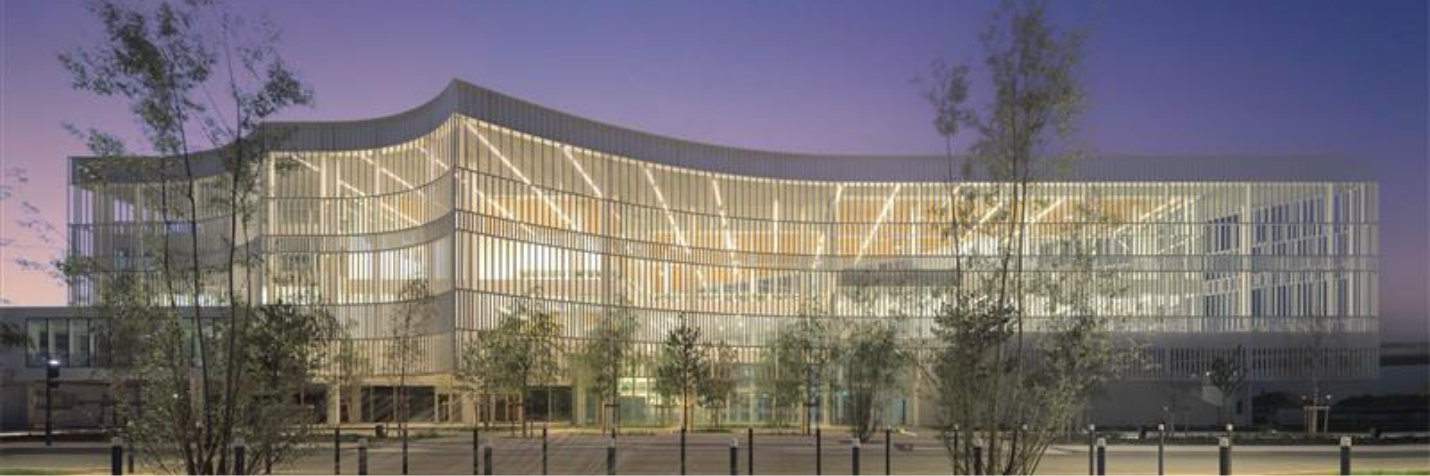
Université Paris-Saclay’s main campuses are situated about 20 km (12 miles) southwest of Paris, sprawling across Orsay, Gif-sur-Yvette, and Bures-sur-Yvette in the Essonne department. The urban Plateau campus (approximately 200 ha/50 acres) houses major faculties, Grandes écoles (such as CentraleSupélec and ENS Paris-Saclay), the notable Lumen library, and cutting-edge laboratories. The Valley campus, centered around Orsay’s Château de Launay, hosts historic science departments, libraries, and numerous research centers. The cluster benefits from natural wooded surroundings and proximity to RER B and new metro 18 transport lines, blending innovation, collaborative learning, and serene campus life.
Student life is vibrant and diverse, supported by strong associative culture — disciplinary, cultural, and representative associations — as well as communal hubs like the MaPS (Maison des étudiants), which is autonomously managed by students and fosters collaboration and social activities.